
Summary: When used in the proper formulation, substrate preparation, waterproofing, sealing, installation, and maintenance, moroccan plaster can be used successfully in damp bathrooms and kitchens. For walls in areas that come into contact with water, covering with seamless and water-resistant material is especially effective; for existing walls in bathroom environments where water is not a direct exposure, modern Venetian plaster is more appropriate.
Moisture can quickly expose the weaknesses of an interior finish. Bathrooms face steam and direct water, while kitchens deal with humidity, splashes, grease, and frequent cleaning. Moroccan plaster offers a distinctive solution, combining a seamless mineral surface with water-resistant properties when properly installed and maintained. But how does it actually perform under demanding conditions? Understanding its composition, application requirements, and limitations can help determine whether this handcrafted finish is the right choice for moisture-prone spaces.
Bathroom Performance: Where Moroccan Plaster Excels
Decorative wall finishes in bathrooms are one of the most challenging applications to install. Humidifying via steam, showering (direct exposure), and frequent cleaning (additional chemically induced stress) all occur.
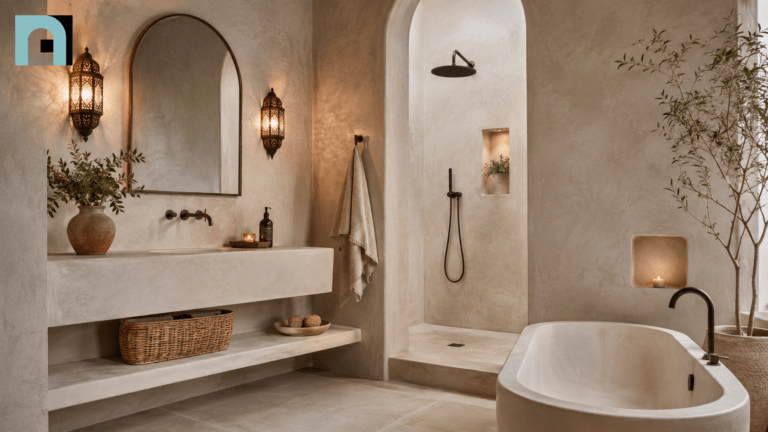
With a perfect finish, the moroccan plaster can create a smooth finish that replaces the need for any kind of grout lines. This is especially aesthetically important since the continuous finish produces a more serene and architectural look. It can also remove the grout lines so often found in tiled walls, but the substrate, waterproofing system, detailing and workmanship still play an important role in the durability of the wall.
The material works particularly well on bathroom walls, shower surrounds, niches, around curves and points where a flush finish is desired. It also tracks curves and has some built-in architectural elements that allow designers even more flexibility than rigid finish materials.
How It Performs in Kitchens?
It’s a different moisture problem in the kitchen. Surfaces generally are subjected to cooking steam, water splashes, grease, food residue, and cleaning over and over again, instead of continuous shower spray.
The conditions where moroccan plaster is most suitable are on walls and backsplashes which are subject to occasional moisture, but are not constantly wet. The seamless look of its front may visually bring the backsplash, wall, and cabinets together, creating a unified interior layout.
But not all kitchen surfaces need the plaster. The areas to be specified have to be carefully considered when there are sinks or fixtures nearby, or areas are exposed to standing water for a long period.
Moroccan Plaster vs. Modern Venetian Plaster in Wet Areas
Now the difference between Moroccan plaster and modern venetian plaster is crucial when choosing the right finish for a wet space.
Both can be used to offer complex mineral depth, movement, and a handcrafted look. But they shouldn’t be considered as alternatives to each other without question.
Traditional Tadelakt-style moroccan plaster has been traditionally used with a variety of soaps, burnishing, and lime, which makes it a very special type of traditional mortar to be used in water-resistant applications. In comparison, modern venetian plaster is not recommended to be applied on bathroom walls outside of areas exposed to moisture – except for various types of Venetian plaster that have been modified for such moisture resistance.
Installation Quality Determines Long-Term Performance
Even the right material can be a poor performer with inconsistent use. The quality of substrate preparation, application technique, compression or burnishing, sealing, curing conditions, and detailing are all important to moisture-resistant plastering.
The installing party should have knowledge of the particular plaster system and should not approach it as a wall plaster system since it differs. Technical documentation may include messages regarding environment, application needs, compatible substrate, maintenance instructions, and non-applicability of product.
Whether a shower or wet room, it is important to waterproof behind the decorative finish, especially in this case. Plaster shall be used as part of an assembly, not as an assembly on its own.
Maintenance Is Part of the Material Specification
Plaster’s performance does not stop when it’s installed. If designed and cared for properly, it can help maintain its protective capabilities and visual features.
Surfaces should generally be cleaned following the manufacturer’s recommendations with the use of suitable non-abrasive cleaners. Excess water should not be left on the surface where it is not needed at all, and in some cases re-soaping might be beneficial if water is splashed on some Tadelakt systems repeatedly.
This is a maintenance requirement, and it’s not a bad thing. Rather, it is indicative of a handmade mineral finish. Some slight variation of tone, patina, and aging can enhance the character of the material, rather than be faulted.
The Right Finish Depends on the Right Application
The better the moroccan plaster looks, the stronger the case for using it is in bathrooms and kitchens, but it isn’t enough. The key to its use lies in the blending of chemistry, workmanship, consideration, and detail in the application of its value.
It offers a refined choice to traditional tile in moist environments and bathroom walls, notably in areas where humidity is high and detailed work is required. When properly specified, it can provide continuity and texture to kitchens, providing backsplashes and other kitchen surfaces that experience normal humidity and splashing.
With modern venetian plaster, though, the area where it can be directly exposed to water remains an attractive use. It’s important to match the finish to the moisture rather than choosing a plaster because of its aesthetics.
FAQs
1. Is Moroccan plaster waterproof?
This traditional Moroccan plaster is very water-resistant and water-repellent when it is correctly treated and polished, in Tadelakt fashion. This should not, however, automatically be assumed as a replacement for code-compliant waterproofing membranes in wet spaces such as showers. (
2. Can Moroccan plaster be used inside a shower?
Yes, there are certain Tadelakt shower and wet-room systems. Full installation includes proper substrate preparation, waterproofing, drainage, detailing, and professional application.
3. Is Moroccan plaster suitable for kitchen backsplashes?
It can be used for kitchen backsplashes with normal splashes and intermittent humidity if a specific kitchen-backsplash-approved product is used. The specification and installation of products for constantly wet areas must be carefully considered.
4. How does Moroccan plaster compare with modern Venetian plaster?
The Moroccan plaster that is created in the Tadelakt style is more commonly used in places where water is a possibility, such as wet rooms, while Venetian plaster is more often used in places likely to experience some humidity but certainly not constant exposure to water.
5. What is the proper maintenance of plaster in Morocco?
Gentle, non-harmful cleaning compounds and drying are usually key factors in maintenance; however, the type of system will vary. In some Tadelakt systems, the water repellency has to be maintained by the periodic application of soap.
